

Welcome to Ep. 3 of the “Dogfood” series, where I’m going to dive into goals, insights, and results, starting with Lever 4: Sleep. This is a pretty long piece so if you just want the topline summary I provided one below.
One caveat before we dig in: This isn’t a scientific paper and I’m not pretending to be a researcher, doctor or data analyst — the internet has plenty of “experts” like that. I’m just a curious person with a fitness tracker and access to some standard AI tools trying to look for trends and insights that align with the themes we talk about on the podcast.
Topline Summary
🛠️ I made some small, incremental changes to my sleep habits based on advice from Lou’s book and our podcast.
📊 I tracked sleep performance over 90 days and saw improvement in three of the four metrics (the fourth stayed flat) I was tracking. I used AI to help me review the data and look for patterns and changes.
⏱️ The most impactful change was in sleep duration — my average went from 6.96 to 7.32 hours/night. This 20-minute increase helped me reduce a compounding sleep debt and it was a noticeable change that I could feel.
🔗 There are some indications of a relationship between sleep consistency (going to bed and waking up at consistent times) and recovery. A 5% increase in consistency showed some correlations that are worth exploring.
🎯 For me, the ultimate takeaway of this summer sleep experiment is that I think we are on the right track with Thrive A/F. I made some small changes to an existing routine based on Lou’s book and our podcast, and those are turning into sustainable habits and results that I can measure — and I feel better as a result!
👇Read on to get the details — what I changed, how I measured it, results across different metrics, insights and closing thoughts!
In case you missed the previous articles in this series, here is a quick recap:
Ep. 1: The “Why” — Set the foundation for taking some of the health and longevity advice from our podcast and Lou’s book and testing it out myself. The core mission: make sustainable habit changes across Sleep, Movement, and Nutrition without over-engineering daily life.
Ep. 2: The “How” — Looked at the tech powering the experiment. We covered using fitness trackers for baseline biometrics and leveraging AI tools (Gemini and Whoop AI) to track habits, analyze patterns, and guide daily choices.
In the sleep episode I talked about shifting from a passive mindset to a more active approach, and in the technology episode I talked about using my fitness tracker to track and improve sleep consistency and reducing my sleep deficit by implementing strategies from the podcast.
For measurement I used my Whoop to establish a 30-day baseline, followed by a 60-day optimization period with monthly reports, and capped off with an additional 10 days of detailed daily tracking.
What Changed: I made some tweaks to my sleep routine based on cues and things I learned from our podcast episode:
I added two common bedtime supplements to my routine: magnesium and melatonin.
I set an alarm every morning even if I didn’t need to get up at a specific time. I was in the habit of getting up early if I woke up before my alarm, and I wanted to teach myself to resist the temptation to get up earlier than I needed to and spend more time in bed (even if I was unable to get back to sleep).
I made an effort to make my sleep more consistent, mainly by getting to bed close to the same time every night.
I started using some basic breathing exercises as a way to try and get to sleep if I was having trouble, and get back to sleep if I woke up before my alarm.
If I had a poor night’s sleep, I tried not to stress about it.
The Detailed Breakdown
Whoop uses three* primary physiological metrics to monitor and evaluate sleep performance and cardiorespiratory state during rest:
Sleep Duration: total daily time spent asleep in hours, which captures both primary overnight sleep and any recorded naps.
Resting Heart Rate (RHR): Tracks heart rate, measured in beats per minute (BPM), specifically while asleep.
Respiratory Rate: Tracks breathing frequency, measured in respirations per minute (RPM), during sleep.
* I also added Sleep Consistency which measures how similar sleep and wake times are over a 4-day period.
This chart shows the baseline measurement and improvements over the two “optimization” phases and the net results. I’m only sharing the results for the heart rate and respiratory rate (not the actual numbers) because there are some things I want to keep private.
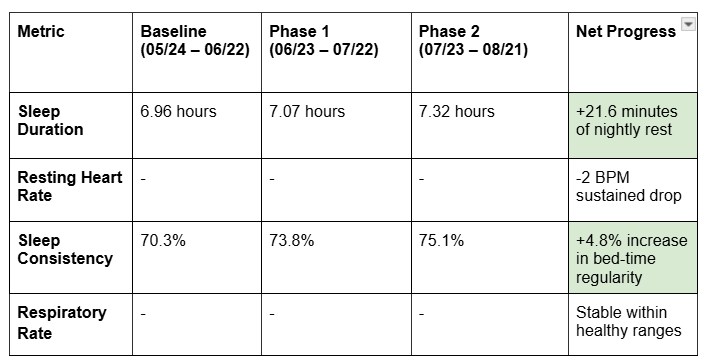
The areas where I felt the most difference and got the most benefit were sleep duration and sleep consistency. While there are a lot of factors that can influence the outcome, I think the intentional behavioral changes I made were a big factor.
Because I was running a small but compounding sleep deficit, adding an extra 20 minutes on average was a difference I could feel. On paper it looks trivial but as we emphasize on the podcast, progress isn’t always achieved through massive behavior changes — it’s frequently gained in the margins through small, compounding habits.
If you run 20 minutes short of your sleep need every night, that accumulates to nearly two and a half hours of sleep debt by the weekend. Over a month those extra 20 minutes add up to over 10 hours of bonus sleep, chipping away at a running sleep debt before it can snowball into a real recovery drag.
While sleep duration is the most obvious change, the underrated hero of this experiment may be sleep consistency. When you anchor your bedtime, you align with your body’s natural circadian rhythm allowing you to spend more time in restorative, deep sleep stages that can’t simply be made up by sleeping in later.
Unlike sleep duration, I didn’t feel the immediate impact of improving sleep consistency by almost 5%, but here is an example of how it can impact recovery:
Night 1 (August 28): I slept for 410 minutes but had a 67% sleep consistency. My sleeping Resting Heart Rate (RHR) increased by 5 BPM, landing me in a 34% yellow recovery.
Night 2 (August 29): The next night, I got virtually identical sleep (409 minutes) but I anchored my bedtime, locking in an 81% sleep consistency. My sleeping RHR dropped 5 beats, and my recovery rebounded to 50%.
The data exported from my Whoop is full of examples like this that show some correlation between sleep consistency and recovery. Are there other factors that come into play? Of course there are — but now if I want to, I can go deeper and look for additional connections when I have the time.
I don’t know for sure if the two supplements I added had any effect, but they sure didn’t hurt. Since magnesium and melatonin are safe and pretty standard supplements I’m going to keep using them as well.
Final Thoughts: One of the best things about focusing on sleep is that if you have a fitness tracker, once you make changes to your routine the device does the work for you. Unlike food or exercise logging, it is just passive data collection and there aren’t any extra steps to getting good information and insights.
I could have used Whoop’s built-in AI for the analysis, but I preferred to download monthly reports (easily accessible in the Whoop app) and then a full export of detailed daily logs. Then I loaded it all into Gemini Notebook/NotebookLM and started asking questions to analyze the data. Since the Whoop AI is only available on the phone app and I’m well A/F (After 40), I prefer working on a big screen and keyboard.
Most of the conclusions were pretty obvious from the standard monthly reports, so I’m not sure if I need all the data from the export. But if I ever want to go back and do deeper dives or cross-tabulation with the full data export I can use the AI for that as well.
Now I need to do my best to stick to the new routine and hopefully the trends will continue to show improvement. The next topic I’ll cover will be Nutrition, and I’ll follow a similar approach with a few tweaks.
As always, thanks for reading — if you’ve made it this far and really want to dig into the details or swap stories about sleep or health tech, reply to this email or post a comment on Subtack and I’ll get back to you!
Keith | Thrive A/F Team