

A new Thrive A/F experiment this week! I put together a video on our YouTube channel to go along with this week’s story about a recent camping/fishing trip. If you haven’t checked out our YouTube channel follow us at https://www.youtube.com/@ThriveAF.
My friend Karl Kortemeier invited me to join a group from the Atlanta Fly Fishing Club on a two-day float down the Ocmulgee River. If you listen to the podcast, you’ve heard me call Karl my ‘Fishing Sensei’ for his uncanny ability to catch fish anytime, anywhere. Even though I’m not a fly fisherman, I couldn’t pass up a couple of days learning from the Master and meeting some fellow fishing enthusiasts.
The plan was to camp Friday and Saturday night at a friend’s property on the river but I couldn’t arrive until Saturday morning. The campsite—a grassy field right at the water’s edge—was ideal. After meeting up with the group Saturday morning, we loaded-up our gear and boats (mostly kayaks and one raft) and headed to the put-in just south of Juliette Dam.
The Ocmulgee flows 255 miles through central Georgia toward the Atlantic. The section we were paddling offered mostly calm water punctuated by mild shoals. My experience kayaking rivers is limited and I got hung up on a few ledges, but overall navigation was fairly straightforward and not too challenging.
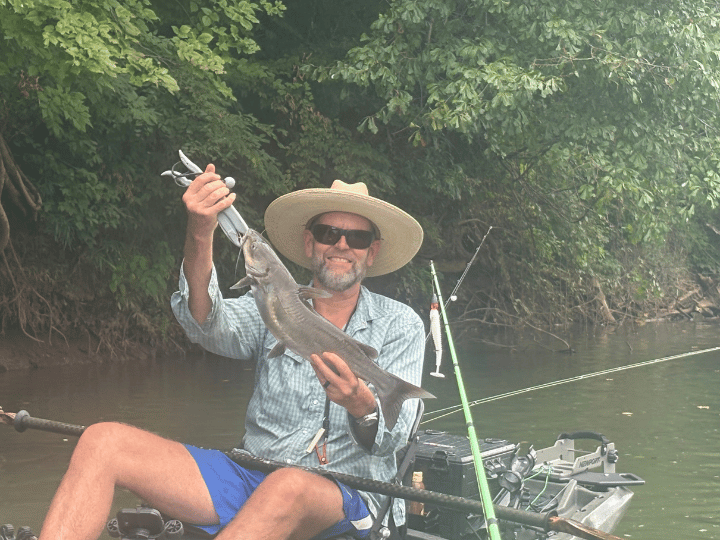
Our main target was shoal bass, though we also landed largemouth, spotted bass, and a big channel catfish caught by Karl. Shoal bass love moving water and they tuck in behind boulders, ledges, and drop-offs where the current slows, waiting to ambush prey swept downstream.
Having floated another section of the Ocmulgee with Karl, I was familiar with the drill for fishing shoals. The technique he taught me: drift over a shoal, execute a quick turn, and either idle in the eddy or drop anchor facing upstream. From there, you cast right into the break where fish hold.
On larger shoals, another option is anchoring, wading out or climbing up and casting from the rocks. The upside: you can cover more ground without constantly resetting the anchor. The downside: those rocks can be slick and the current is deceptive—as you’ll see in the video, taking a spill is easy even when you’re being careful.
Fishing has a reputation for being sedentary, but Saturday was anything but. We spent nearly ten hours on the water—a long day of casting and maneuvering, even going with the current. It became an endurance test punctuated by quick, aggressive bursts of paddling to shoot shoals or hold position upstream.
The real challenge was the heat, but we found plenty of chances to jump in and swim. An afternoon rain shower cooled things off considerably, making Saturday night’s sleep much more comfortable (even if it stayed pretty warm).
Most of the fish I caught were small but aggressive, feeding right through the heat of the day. Sunday morning after breakfast, we broke camp and did a quick float to a boat ramp a couple of miles downstream to close out the trip.
The Atlanta Fly Fishing Club was incredibly welcoming and didn’t give me any grief for using a spinning rod. Watching them work and listening to them trade stories and technique around the campfire gave me a real appreciation for the art form. If you’re in the Atlanta area, I highly recommend checking them out—I know they have more trips planned this year!
💬 Have you ever taken on an outdoor activity expecting a relaxing day, only to end up in a surprisingly intense endurance test? How do you handle long days out in the elements when heat or current start wearing you down? Drop a comment below or reply directly to this email to share your story!
Keith | Thrive A/F Team