

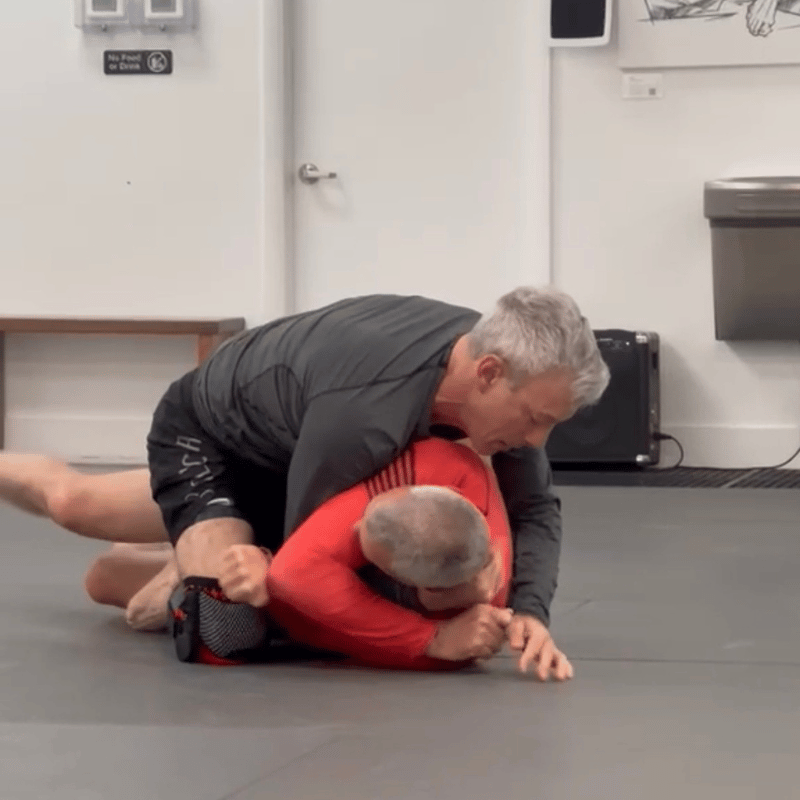
Eight years after stepping away from Brazilian Jiu-Jitsu, I found myself back on the mats at age 56.
To be honest, returning was intimidating.
The physical part didn’t worry me nearly as much as the psychological part. As a brown belt, I carried a healthy dose of imposter syndrome. I wondered if I still belonged. Had the sport evolved beyond me? Would I be the worst brown belt ever? Could my older body still adapt to the demands of grappling? Would I be able to handle the bumps, bruises, and challenges that come with training?
Walking back into the academy felt a little like stepping into a time machine. Some things were familiar. Other things felt completely new.
What surprised me most wasn’t whether I could still perform techniques. It was how differently I approached the entire experience.
Years ago, I measured success by who I could beat. Today, I measure success by whether I get to come back and train again next week.
That shift changed everything.
🥋The Behind-the-Scenes Prep
During my years away from BJJ, I never stopped preparing my body.
I continued strength training for my core, upper body, and lower body. For conditioning, I regularly used my rowing machine and Airdyne bike. I also invested time in mobility, flexibility, recovery, sleep, and nutrition.
But the biggest change wasn’t physical—it was philosophical.
In my 40s, my training was largely ego-driven. Every sparring round felt like the world championships. I pushed myself through brutal workouts designed to make me tougher, stronger, and impossible to tire out. The result was constant soreness, nervous system fatigue, and increasing pressure to prove I still had “it.”
In my 50s, I play a different game.
I still enjoy the competition, but I’m competing primarily against my former self. My goal isn’t to win every round. My goal is to train for decades.
I choose training partners carefully. I prioritize recovery. I pay attention to sleep. I avoid unnecessary wear and tear. Most importantly, I never allow one sparring session, one week, or even one month to outweigh the bigger mission: training and enjoying Jiu-Jitsu for the rest of my life.
⚡The High-Thrive Moment
The biggest victory wasn’t a sweep, submission, or successful round.
It was having the courage to return and realizing that I genuinely enjoyed being there.
I found myself grateful—not for how I performed, but for the opportunity itself.
I train at an academy filled with supportive people who genuinely want to improve while helping others do the same. The camaraderie is outstanding, and I was welcomed back with open arms. The culture emphasizes growth over ego. Younger students push me to improve and make me feel alive, and I take great satisfaction in helping newer practitioners develop their skills.
At 56, I no longer feel the need to prove that I’m tough.
Instead, I feel fortunate that I still get to participate in something that challenges me physically, mentally, and emotionally.
That’s what thriving looks like to me.
Not domination.
Not perfection.
Simply having the health, preparation, and mindset to continue showing up for adventures that matter.
💬 What sport or passion have you returned to after a long break? Or, if you’ve been at it consistently, how has your definition of "success" changed as you've gotten older? Leave a comment below or reply directly to this email to share how you're playing the long game!
Lou | Thrive A/F Team
This hit home, Lou. I'm a lifelong skater and the founder of Old Bones Therapy (the brace that snuck into your lead photo), so I came for the gear cameo and stayed for the actual story.
That line about measuring success by whether you get to come back and train again next week is the whole thing. Skating after 50 is the exact same shift. In my twenties it was about landing the gnarliest trick and not backing down from anything. Now it's about still being able to drop in tomorrow, picking my moments, warming up like it actually matters, and protecting the body so this stays a thing I get to do for decades instead of a thing I used to do.
The mental hurdle you describe, the "has the sport moved on without me, am I kidding myself" voice, is identical whether you're stepping onto the mats or back on a board after time away. Pushing through that is the real win. Everything after is just bonus reps.
Congrats to you and Keith on Thrive A/F. Subscribed, and rooting for the comeback.
Brandon