

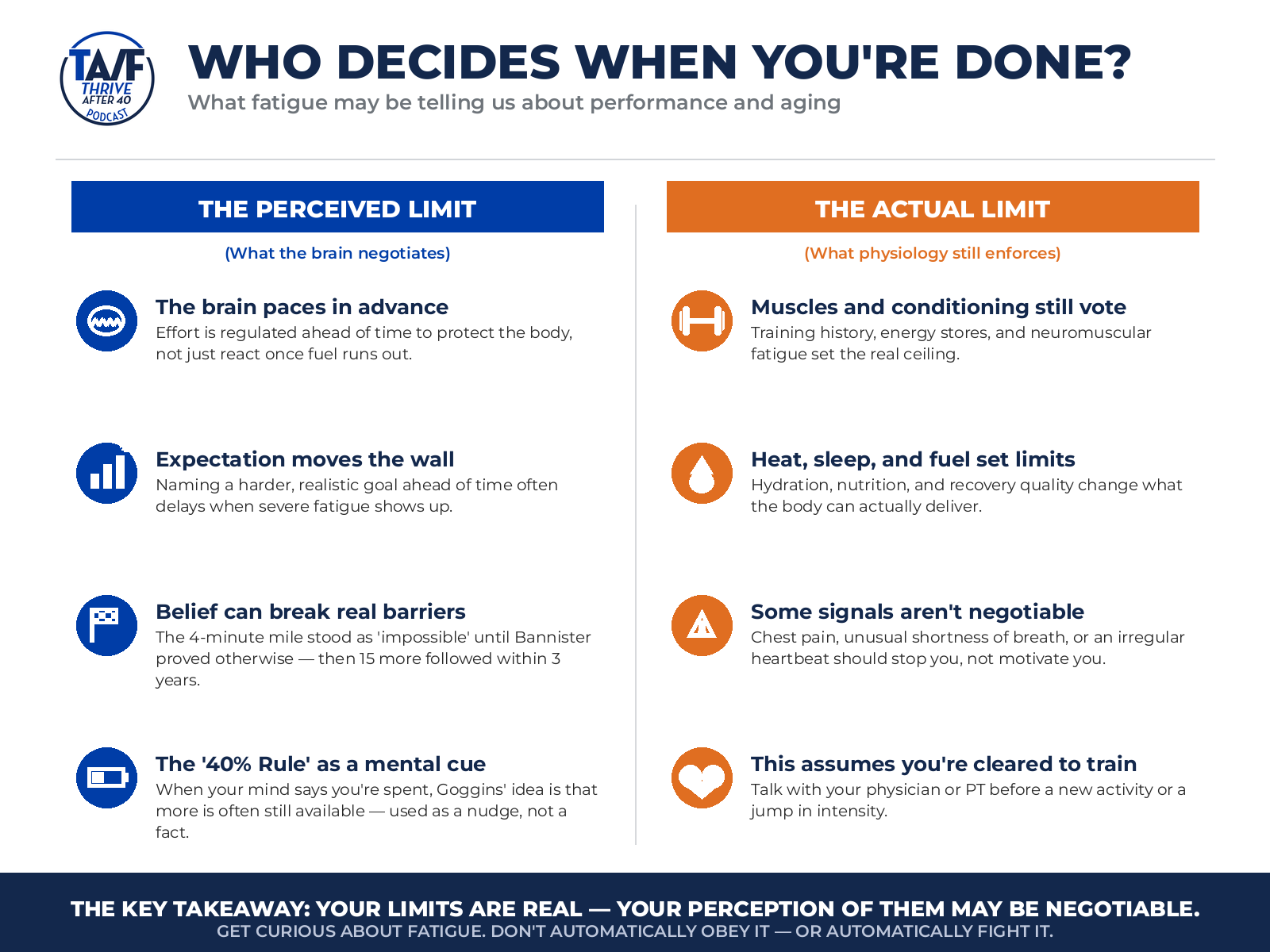
This is the first installment of a two-part series on fatigue and recovery. Both matter enormously for those of us over 40. First, ignoring either can wreak havoc on your performance and your health. I see the consequences of both all the time in my practice. Second, the harder you push yourself, the more fatigue you’ll experience and, therefore, the more recovery you’ll need to restore your body and nervous system.
Recovery is when your body repairs and rebuilds itself. That’s when you adapt to the work you’ve done and become stronger, more powerful, and better conditioned. Push through fatigue without recovering properly, and you raise your risk of injury and burnout because your body and nervous system never get the time they need to fully adapt.
There’s another piece of this that matters, especially when you’re taking on something new: when you start an activity your body isn’t accustomed to, it’s generally better to ease in than to go “hog wild” and push your limits right off the bat.
So how do we decide how far to push ourselves during training, or any challenging activity?
Here’s something I’ve noticed in my own training. I do a lot of push ups, so I know my capacity well. If I decide beforehand that I’m doing a number I know will be very challenging (right around my limit), it’s remarkable how often I begin feeling seriously fatigued right around that number. But if I decide ahead of time that I’m doing five more (obviously harder, but still realistic), the wall often seems to move with me.
That raises an interesting question: Why should knowing the number change when I feel exhausted?
Exercise physiologist Tim Noakes may have the answer. He has spent decades challenging the simple idea that fatigue is merely an empty gas tank. His Central Governor Model* proposes that the brain plays an important role in regulating effort in anticipation, continually adjusting how much we’re willing or able to recruit in order to protect the body and preserve homeostasis. It’s one possible explanation for familiar phenomena like pacing, then somehow finding another gear when the finish line comes into view.
Anyone who has trained Brazilian Jiu Jitsu knows the feeling. You’re exhausted, and the round feels endless. Then you catch a glimpse of the clock and there are only thirty seconds left. Remarkably, you find some additional resources to draw on.
Does that mean fatigue is imaginary? Absolutely not. Muscles fatigue. Energy availability, previous training, and conditioning all matter. Heat, hydration, cardiovascular strain, sleep, pain, nutrition, and neuromuscular factors all matter. The Central Governor Model* itself remains debated, and fatigue is probably better understood as a complex interaction between the brain, the body, AND our perception of effort.
But to me, this complexity is the most fascinating part.
Within the realm of our actual physical capacity, our expectation of where the endpoint lies seems to influence when severe fatigue arrives. For example, I can’t simply tell myself I’m doing 125 push ups and magically create the physiology to do it. After all, physiology still gets a strong vote. But perhaps our perception of exactly where the limit sits is more negotiable than we think.
One mind trick I often use when I’m feeling the burn but know I still have a ways to go is the “40% Rule,” an idea popularized by former Navy SEAL David Goggins: when your mind is telling you that you’re completely spent, Goggins believes you still have 40% left. I don’t take that as a literal physiological measurement, but I do use it as a cue to push through to my goal.
And guess what? It works!
That brings me to aging and what Keith and I discussed in our second podcast about Lever 1 in my book, Thrive: A Physical Therapist’s Guide to Longevity. In that episode, we repeatedly returned to the idea: Whether you think you’re old or young, you’re right.
I believe there’s something powerful behind that statement and that our minds function more like projectors than cameras. Our previous experiences, thoughts, expectations, and beliefs shape our perception of reality, and that applies to how we age as well as how we experience a given activity or exercise.
For example, psychologists Mukta Bhalla and Dennis Proffitt at the University of Virginia found that our physical state can influence how challenging we perceive our environment to be. People in poorer physical condition tended to judge hills as steeper than those who were more physically fit. In other words, the hill itself had not changed, but the brain’s perception of the challenge appeared to change depending on the person’s physical condition. Presumably, being fitter made the effort required to climb the hill feel more manageable, and that altered how steep the hill appeared.
Roger Bannister’s historic four-minute mile offers another powerful example. Before Bannister accomplished it in 1954, running a mile in under four minutes was widely viewed as a barrier beyond human capability. However, on May 6 of that year, Bannister ran it in 3 minutes and 59.4 seconds. Then, just 46 days later, Australian runner John Landy broke the barrier as well, recording a time of 3 minutes and 58 seconds. By the end of 1957, 16 runners had recorded a mile in under four minutes!
That says a lot, because human physiology had not suddenly changed in those three years. Improvements in training and competition certainly contributed, so perception was not the whole story. But Bannister gave other runners undeniable proof that the barrier could be broken. Once they knew it was possible, the four-minute mile no longer represented an impenetrable wall. It became an extremely difficult but ACHIEVABLE goal. Sometimes, seeing someone else cross a boundary allows us to reconsider where that boundary really lies.
Which raises a much bigger question:
⁉️ How many limits do we encounter as we get older because our physiology has genuinely changed, and how many are simply predictions we’ve gradually learned to make about ourselves?
We hear that people our age shouldn’t run, lift heavy things at CrossFit, learn difficult skills, spar on a jiu jitsu mat, or take on something that scares us. Eventually, some of those cultural expectations become our own.
The lesson here isn’t to ignore fatigue. Sometimes fatigue is exactly the message we need to hear: recover, slow down, or stop. The better approach is to get curious about it.
❓ Is this a true warning or just my incorrect perception? Could this be an overprotective response arriving a little early?
An important note: this discussion assumes you’re medically cleared and appropriate for the type and intensity of exercise and activity you’re doing and don’t have a medical condition, injury, or restriction that limits you. Always talk with your physician or physical therapist before starting a new activity or significantly increasing your exercise intensity.
Additionally, some signals shouldn’t be negotiated with. There’s a difference between the familiar discomfort of working hard and symptoms that deserve attention, including but not limited to:
New or unusual chest pain or pressure
Significant or unexplained shortness of breath, dizziness, or feeling faint
A fast or irregular heartbeat
Sudden weakness, or sharp or escalating pain
These are not invitations to prove how tough you are, and wisdom isn’t simply learning how to push harder. It’s learning which signals can be challenged and which ones should be respected, and getting this right becomes even more important as you age.
Your limits are real and need to be respected, but your perception of exactly where those limits are may be negotiable.
So the next time your mind says, “That’s enough. You’re done,” maybe don’t automatically fight it.
On the other hand, don’t automatically obey it either.
🧐 Get curious. Who decided?
Learning that we may occasionally have more in the tank doesn’t mean the answer is always to push harder. Stress is only half of the adaptation equation. The other half is recovery, and as we get older, how well we recover matters every bit as much as how hard we can train, if not more.
That’s what I’ll discuss next: recovery. Not as weakness, laziness, or time away from training, but as an essential part of the training itself.
Because thriving after 40 isn’t about proving you can always do more. Rather, it’s about learning when to push, when to recover, and how to keep doing the things you love for decades to come.
Thrive A/F: for people who refuse to let age decide what they can do.
🗨️ Join the Conversation:
Think of a time your mind told you that you were done before your body actually was. What did you do, push past it or respect it?
What about a time when you thought an activity was going to be harder than it was, only to realize afterward that it wasn’t so bad?
Leave a comment and share your story. We’d love to hear how you tell the difference between a real limit and a made-up one.
Lou | Thrive A/F Team
*Important Note: The Central Governor Model is an influential but debated theory of exercise regulation. It’s presented here as a useful framework for thinking about fatigue, not as proof that fatigue is purely psychological or that physiological warning signals should be ignored.