

In Part 1 of this series, we explored the idea that fatigue does not always mean we are finished. In Part 2, we discussed why recovery is essential if we want our bodies to repair, adapt, and become stronger.
Both ideas are true, but I decided there is a third piece of the conversation we can’t ignore especially in today’s technologically dominated era:
What happens when conditions are less than perfect, or when we’re not fully recovered, but we still must perform?
So, I decided to include this third installment in an attempt to come up with an answer or at least stimulate some debate.
Here’s the Reality, Life Does Not Check Your Recovery Score
I recently heard a neurosurgeon discuss this in an Instagram post (@itsbrainsurgery). In it, he explained that he cannot refuse to perform emergency brain surgery simply because his wearable says he is poorly recovered or because he had a bad night of sleep. If someone needs him, he has no choice but to step up and do his job well.
Most of us will never face emergency brain surgery, but we all encounter moments when life doesn’t give a !@#$ about our recovery score. For example, when a family member needs us or a crisis develops at work, or when we have to compete, travel, make a decision, or fulfill a responsibility when we do not feel our best. Let’s face it:
Often, we do not get to choose the conditions.
Life Cannot Be Optimized
We can monitor sleep, plan training, manage nutrition, and create the best conditions within reason, and these things matter, but life cannot be completely optimized. As the saying goes, “the best-laid plans of mice and men often go awry”.
For example, I can think of times when my daughter became sick, my flight was delayed, or I slept poorly before an important event. The fact is if something needs to be done, no one really cares what our wearable says. In fact, if we convince ourselves that we need ideal conditions to sleep, exercise, think clearly, handle stress, or perform well, I would argue that we are actually training ourselves to be fragile.
And if you cannot perform when the going gets tough, eventually you are going to have problems, because sooner or later, the going gets tough.
Good Conditions Should Not Become Requirements
I am not saying that recovery is not important or that we should intentionally and repeatedly exhaust ourselves. After all, that’s what part 2 was about, and it’s well documented that chronic sleep deprivation and inadequate recovery carry consequences for health, judgment, reaction time, mood, and performance.
But, I am saying that there is an important difference between creating good conditions and becoming dependent on them.
A quick hat tip belongs to author and thinker Nassim Nicholas Taleb, who coined the term “antifragile” in his book Antifragile: Things That Gain from Disorder. Taleb says that something resilient can withstand stress and recover from it. Whereas, something antifragile goes a step further: it benefits from stress, disruption, or uncertainty and becomes stronger or more capable because of it.
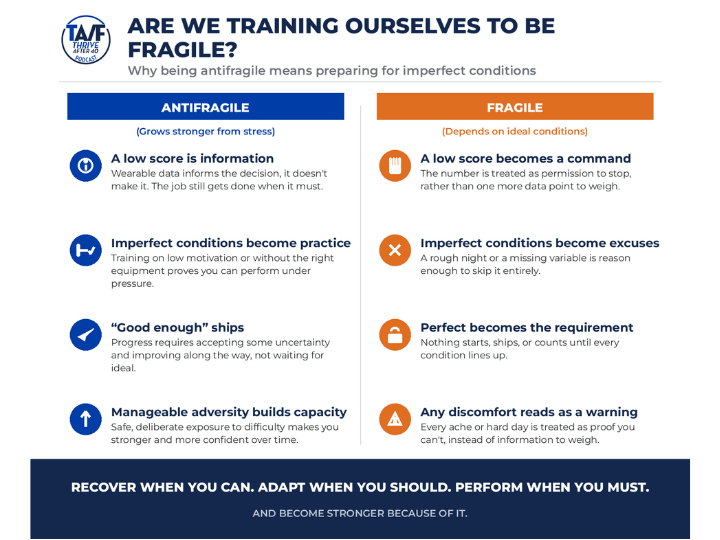
Being antifragile means learning to operate when conditions are not ideal and then becoming stronger because of it. At times, we may need to modify the plan or accept that we will not perform at our absolute best.
This happened when I published my book, Thrive: A Physical Therapist’s Guide to Longevity. Each time I reread it, I found more ways to improve it. I am a recovering perfectionist, so it was difficult for me to finally accept that the book had to be “good enough”, or I might never have published it at all.
Waiting for perfect conditions would have kept me from moving forward. Publishing it required me to accept some uncertainty, act before everything felt ideal, and trust that I could learn and improve along the way. In that sense, imperfect conditions did not prevent progress — they became part of the process.
If modifying the plan is not an option, we simply have to put our heads down, tough it out, and do what needs to be done anyway.
Toughness Is Also Trainable
Antifragility tells us that we become stronger by exposing ourselves to an appropriate amount of physical stress and then recovering from it. Each time we successfully navigate discomfort, fatigue, or disruption, we prove that imperfect conditions do not make us fall apart. They help us become even more capable. However, that does not require frequently staying awake all night or performing dangerous activities while exhausted.
Instead, we can do things like complete a workout when motivation is low, adapt when equipment is unavailable, remain calm when plans change, exercise outside our favorite time, take on a new challenge or face a fear, or fulfill an important responsibility when we would rather rest.
Viewing setbacks as challenges meant to improve us can help us keep a positive attitude when life gives us lemons. But remember, proper balance is key, and the goal is to expand our capacity, not prove that warning signals never matter.
Wearables Are Advisers NOT Commanders
Wearable technology should be viewed in proper perspective. It can provide useful information about sleep, heart rate, and recovery trends (I use it myself), but that information must be interpreted within the context of real life.
A low recovery score may suggest modifying a workout or confirm what our bodies are telling us, but it should NOT convince us that we are unable to perform. Because as anyone over 40 knows, sometimes despite what the data suggests, the job still needs to be done.
Recovery and Antifragility Need Each Other
Recovery without antifragility can leave us dependent on ideal circumstances and more fragile. However, antifragility without adequate recovery can become recklessness, so we need both. As a result, ahead of time we should recover deliberately whenever possible, so that we are ready and have greater capacity when life becomes demanding.
Because our subconscious looks for proof that we can perform under pressure and in less-than-ideal conditions, we should also occasionally tolerate safe, manageable adversity so that we improve gradually (e.g. 1% per week) and do not lose confidence whenever conditions are imperfect.
This also matters as we get older. For example, we should respect changes in our bodies without treating every poor night, ache, or difficult day as proof that we are no longer capable, because as I’ve said before, age gets a vote, but not the ONLY vote.
Do What the Moment Requires
The skill is not about blindly pushing through everything. Rather, it is about learning to respond appropriately. Sometimes the wise decision is to stop, sometimes it is to recover, and sometimes it is to modify the plan.
But sometimes the moment requires us to be tough and continue despite feeling less than perfect. Fatigue asks us whether we have more in the gas tank, recovery prepares us to go again, and antifragility allows us to give what is needed when life does not provide ideal conditions.
SO, recover when you can, adapt when you should, perform when you must, and become stronger because of it!
🗨️ Join the Conversation
Have you ever surprised yourself by performing well after poor sleep, disrupted plans, or less than ideal preparation? How do you distinguish between a moment when you truly need recovery and one when you simply need to tough it out? Leave a comment and share your experience.
Lou | Thrive A/F Team